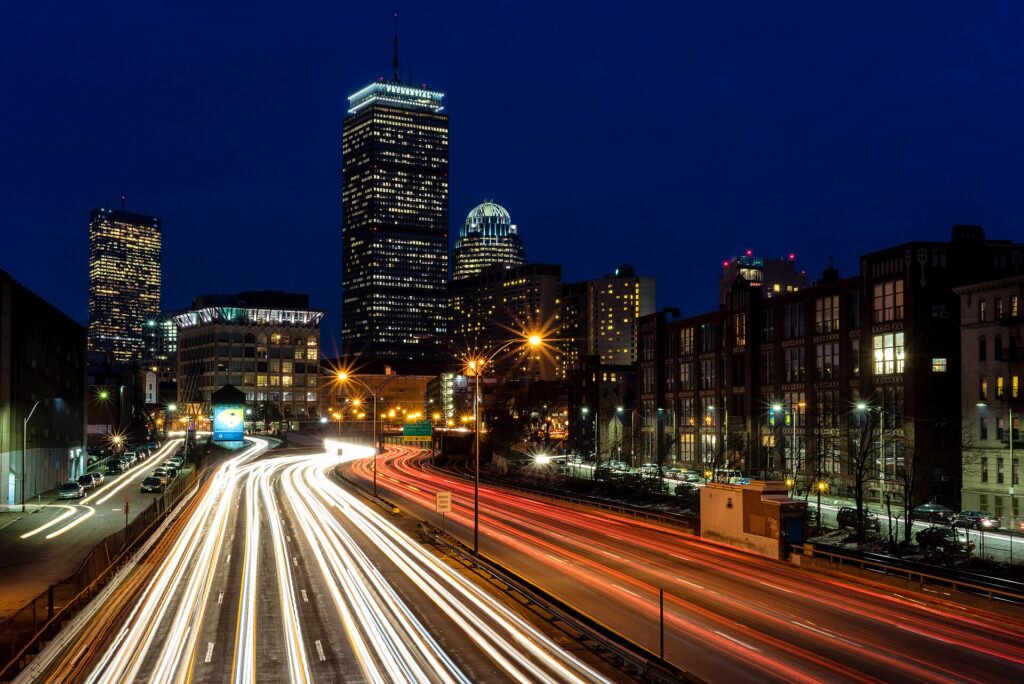
Boston traffic is rough most of the year.
September somehow finds another level.
There is not yet a complete September 2026 dataset showing it is literally Boston’s worst traffic month. But several things hit the road at once: college move-ins, schools reopening, construction still active and the return of full fall routines.
Boston has more than 150,000 college students, and this year the city issued more than 2,500 moving truck permits between Aug. 29 and Sept. 1 alone.
Then schools reopen across the region, putting school buses, family drop-offs, cyclists and pedestrians back into the morning commute just as thousands of students return to neighborhoods like Allston, Fenway and Mission Hill.
Construction adds another layer. September is still an active road-work month, meaning lane restrictions and major projects are competing with the return of heavier fall traffic.
By the afternoon, the roads are already feeling it.
MassDOT found that by 2 p.m., 45 percent of roadway miles inside I-95/Route 128 were already moderately or highly congested, compared with 18 percent in its earlier benchmark.
Afternoon congestion is generally worse than the morning peak.
Boston also ranked as the fifth most congested U.S. city in 2025, with drivers losing an average of 83 hours to traffic.
Where it gets worst
I-93 remains one of the biggest pressure points, especially heading south out of downtown.
The Mass Pike gets particularly heavy heading west during the afternoon commute.
Storrow Drive can also slow quickly, especially when construction, crashes or heavy event traffic reduce capacity.
If you actually have to drive
Cambridge to downtown
If Storrow is backed up, passenger cars can compare Memorial Drive and crossings like Longfellow Bridge with their usual route.
Check live traffic first. The faster option changes quickly.
Heading toward Fenway or Back Bay from the west
Compare Route 9 with the Mass Pike before leaving.
The Pike may save time on some trips but comes with a toll, while Route 9 can become heavily congested during peak periods.
Downtown to Charlestown or Somerville
Compare I-93 with local routes through North Washington Street, Rutherford Avenue and Sullivan Square.
Do not assume the highway is automatically faster for a short trip.
Driving a moving truck
This one is simple.
Do not take a moving truck or other large vehicle onto Storrow Drive, Soldiers Field Road or Memorial Drive.
Those roads are restricted to cars because of low bridge clearances, some as low as about nine feet.
Check your truck height and plan the route before leaving.
When does it calm down?
The worst move-in chaos fades once September gets going and school routines settle.
Traffic itself sticks around.
MassDOT data shows congestion now starts earlier in the afternoon, and many Greater Boston corridors are worse Tuesday through Thursday than on Mondays and Fridays.
So the most useful September habit is simple:
Check the route before leaving, not just the destination.
A road that worked yesterday can be the slow option today.